
Teams That Win Podcast
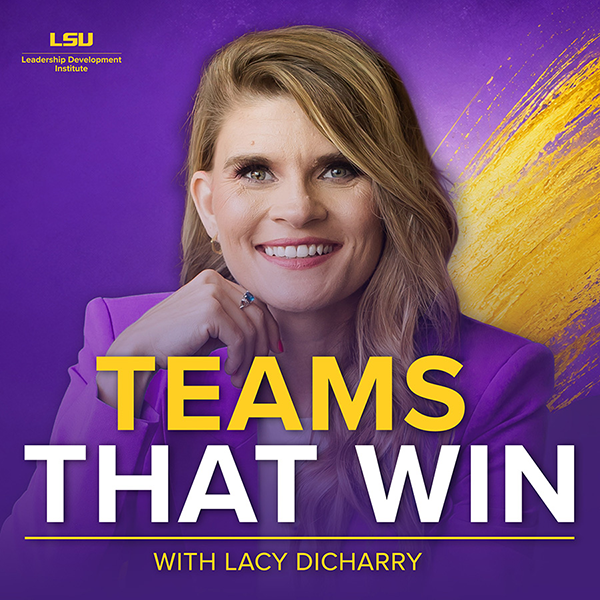
Leadership shapes the people around you every day. Teams That Win explores what it takes to build trust, navigate hard conversations, lead through change, and hold a team together when things get difficult. From psychological safety and managing conflict to transitioning into leadership roles, each episode dives into the questions leaders live with every day.
Hosted by Lacy Dicharry, Senior Director of the LSU Leadership Development Institute, the show draws on more than twenty years of work with teams across states, territories, and countries. New episodes arrive every three weeks on YouTube and Spotify.
Podcast Episodes
Why Change is Physically Painful (And What to Do About It) | Episode 1 with Lacy Dicharry | May 5, 2026
The largest share of a leader’s growth happens in the work itself. The Center for Creative Leadership’s 70-20-10 model puts ten percent of that growth in formal training, twenty percent in the coaching and feedback that follow it, and seventy percent in the daily practice of leading people. That middle twenty percent is where a good workshop becomes a habit, and it is the piece organizations have the most room to build on.
Lacy Dicharry, LDI Senior Director, shares what happened with a hospital executive who arrived with strong technical skills and learned to lead the human side of a system-wide change. She explains why change asks something physical of the people living through it, and how a leader can meet them there.
Topics discovered:
- How to give feedback that a person can hear and act on the same week
- What people need from a leader when a significant change is being asked of them
- How to build a team member’s capacity so you can hand work off with confidence
- How much time strong teams spend practicing compared with time spent performing
- Why unlearning old habits is part of taking on a new leadership practice
- How leadership research reaches people who never sit in a university classroom
What 33 Years of Leadership Will Teach You | Episode 2 with Jerry Monier | May 26, 2026
The strongest individual contributor on a team is often the next person promoted, and leading the people you once worked beside asks for a different set of skills. Jerry Monier calls that first move from buddy to boss the hardest transition in a professional career. He has spent 33 years in public safety learning how to make it well, and how to help the next group of frontline leaders make it too.
Jerry Monier is a Associate Director of Research & Development at LSU’s National Center for Biomedical Research & Training. He traces his approach back to a family farm on Bayou Lafourche, a food bank he stocked shelves at as a teenager, and a sheriff’s office motto about doing whatever it takes to serve the public well. Note: As of August 2026, Jerry Monier has retired from his role at LSU. We wish him nothing but the best in his new chapter of life.
Topics discussed:
- What changes on the day you start leading people who were your peers
- The difference between capacity and capability, and why it shapes how you lead
- How to build a network you can call on to answer almost any question
- Why admitting you do not know everything makes you easier to follow
- What CliftonStrengths reveals about the way your team works together
- How complementary partnerships cover the ground your own strengths do not
How to Support Your Team Through Hard Times | Episode 3 with Shelly Mullenix | June 16, 2026
Leading well starts with being well. Shelly Mullenix built a career on that idea, beginning as a certified athletic trainer and later earning a degree in social work so she could support the whole person in front of her. She describes what happens when a leader stops for five minutes, reads the room, and asks a team member what they need right then.
Shelly Mullenix is Senior Associate Athletic Director for Health & Wellness at LSU Athletics. She shares what she learned standing between coaches and student-athletes, from a championship floor to the days after Hurricane Katrina, about what people carry into work and what helps them keep going.
Topics discussed:
- Why rest and recovery help a team perform at a higher level
- How to read the room, and what to ask when you cannot read it
- What five minutes of a leader’s attention can do for a team member
- How vulnerability from a leader builds trust across a whole team
- Why influence has more to do with presence than with your title
- How a shared purpose holds a team together through a difficult season
Why the Smartest Teams Don’t Always Work | Episode 4 with Natasha Simoneaux | July 7, 2026
How a team interacts matters more for its results than the résumés sitting around the table. Google studied more than 180 of its own teams in Project Aristotle and found psychological safety at the top of the list. Team science calls that an emergent state, something a team develops together over time rather than something any one member arrives with.
Natasha Simoneaux, Business & Operations Manager at LDI, has spent decades leading retail, service, and operations teams. She and host Lacy Dicharry walk through the four stages of psychological safety, how accountability works alongside it, and what a leader can do to build both at the same time.
Topics discussed:
- What psychological safety means, and the myths that grow up around it
- The four stages, from inclusion safety through to challenger safety
- How safety and accountability combine to create a team that learns
- What it tells you when nobody on your team ever challenges your ideas
- Why inviting a challenge leaves your authority and your decision intact
- How to turn a low-performing team around by listening to them first
Two Rules for Seeing Potential in Anyone | Episode 5 with Jennifer Curry, PhD | July 28, 2026
Children begin deciding which careers are for them at five and six years old, and by middle school many have already settled the question of whether they are college material. Jennifer Curry, PhD studies how that happens, and the two rules she gives the adults around those children work just as well on a team at any age.
Dr. Curry teaches in the Counselor Education Program at LSU’s College of Human Sciences & Education and serves as a lead expert consultant on the PBS Kids series Skillsville. She and host Lacy Dicharry talk about identity, adaptability, and what it takes to help a person find work that fits who they are.
Topics discussed:
- Rule one: don’t be a dream squasher, and the questions to ask instead
- Rule two: become an excellent interviewer wherever you happen to be
- Why career readiness begins with identity, interests, and values
- How burnout often traces back to a role that no longer fits the person
- What Dr. Curry means when she calls all of us career chameleons
- Why neurodivergent thinkers strengthen the teams that hire them
How to Delegate When You Struggle to Let Go | Episode 6 with Dr. Xavier Thompson | August 18, 2026
A team that is strong before something goes wrong is able to recover faster, preventing long-term burnout in the process. Dr. Xavier Thompson studies how athletes get hurt and what makes them less likely to, and in this episode, he and Lacy share the principles that can also apply to other workplace environments. This includes establishing clear communication early and being intentional in building trust.
Dr. Xavier Thompson is an Assistant Professor at LSU and a researcher in kinesiology and performance science. He and host Lacy Dicharry talk about the check engine lights a leader can learn to read, the delegation question a mentor once asked him, and why rest belongs in all definitions of performance.
Topics discussed:
- How to set expectations early so a team avoids the conflict that follows confusion
- What soreness teaches us about the early signals a team gives off that something is wrong
- The delegation question: what only you can do, compared with what you can do
- How to hand off work in small pieces and grow what a person is able to take on
- Why rest is part of performance, in a body and on a team alike
- Comparing how much time athletes and team members spend training to shape what they
How to Lead a Team Through Hard Moments | Episode 7 with Beaux Jones | September 8, 2026
Leading a team of specialists means leading people whose work you have never done yourself. Beaux Jones leads geoscientists, biologists, data engineers, social scientists, archaeologists, and lawyers at The Water Institute, each group arriving with its own training and norms for how people talk to one another. He describes what it took to turn a list of core values into a shared agreement that the team could hold each other to.
Beaux Jones is President & CEO of The Water Institute in Baton Rouge, an independent research organization working on coastal and environmental challenges. He and host Lacy Dicharry talk about what changes when your job stops being the work and becomes the people doing it, and what openness from a leader looks like day to day.
Topics discussed:
- How to lead specialists whose training and language differ from your own
- How a leader steadies a team through a loss felt across an organization
- What it takes to turn a list of core values into a shared agreement
- Why accountability starts with naming the behaviors everyone agreed to
- What openness from a leader looks like, and where the line sits
This episode includes a discussion of suicide and its impact in the workplace. If you or someone you know needs support, the 988 Lifeline is available by call or text at 988. The International Association for Suicide Prevention lists resources by country at iasp.info/suicidalthoughts.
Finding Purpose After a Career Change | Episode 8 with Dave Lombardo | September 29, 2026
Every new team comes with a culture already in place, and a leader joining one has to understand it before changing anything. Dave Lombardo describes what he looks for in the first weeks of joining a new team, what helps him identify what motivates people, and why’s learned to not assume where their source of motivation comes from.
Dave Lombardo is Assistant Director of Operations at the LSU Leadership Development Institute, after twenty-four years as an armor officer in the Army and a stretch in Louisiana’s construction industry.
Topics discussed:
- How to read a team’s culture before you set out to change any of it
- What inspired people to do their work
- What relational cohesion theory says about trust and team performance
- The difference between positional power and the influence you earn
- How teams decide by consensus, and when commitment serves them better